

What Attracts Mosquitoes to Your North Carolina Yard?

Quick answer: Mosquitoes are attracted to North Carolina yards primarily by standing water (their breeding site), dense shaded vegetation (where adults rest), and carbon dioxide, body heat, and certain body chemistries in humans. Eliminating standing water, reducing harborage, and applying a barrier treatment during peak months are the three highest-impact steps Charlotte and Piedmont homeowners can take.
You step outside on a July evening, and within minutes you are swatting at mosquitoes. The rest of the yard looks perfectly fine, no pond, no swamp, no obvious problem. So why are they there?
The answer usually comes down to a handful of specific conditions that most homeowners overlook. North Carolina’s warm, humid climate and frequent summer thunderstorms create near-ideal mosquito habitat across the greater Charlotte metro and Piedmont region. Understanding what attracts mosquitoes to your yard, and to you personally, is the first step toward doing something about it.
The Short Answer: What Attracts Mosquitoes?
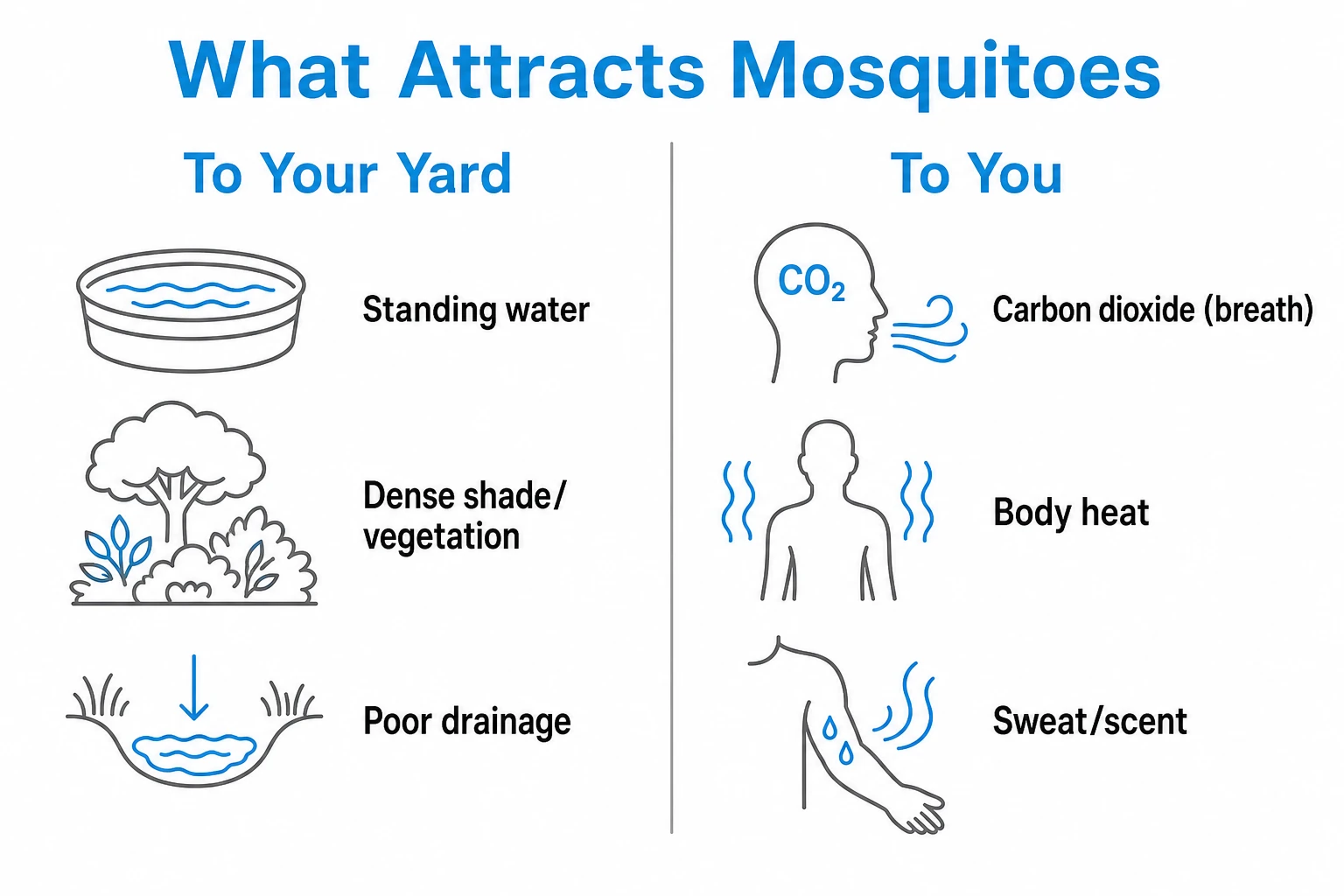
Standing water and shaded vegetation attract mosquitoes to yards. A female mosquito needs only a quarter-inch of standing water to lay eggs, and at summer temperatures common to the Piedmont, those eggs can hatch into biting adults in as little as 7 to 10 days. Adult mosquitoes spend daylight hours resting in dense, shaded shrubs and ground cover, then emerge to feed at dawn and dusk, or all day if Asian tiger mosquitoes (Aedes albopictus) are the dominant species in your area.
On the human side, mosquitoes are drawn to carbon dioxide, body heat, sweat, and certain compounds in blood that vary from person to person. That is why some people get bitten constantly while others nearby seem barely affected.
What Attracts Mosquitoes to Your Yard
Does standing water really attract mosquitoes, and how little is enough?
Yes, standing water is the single most significant yard attractant, and the threshold is extremely low. A bottle cap, a folded tarp, a plant saucer, or a clogged gutter section holds more than enough water to sustain a breeding population. According to NC State Extension, even small containers left outdoors after a summer rainstorm can support developing mosquito populations.
The most overlooked breeding sites in Charlotte-area yards include:
- Gutters. Slow-draining or clogged gutters are the most frequently missed source in residential properties. Check them after every major storm.
- Plant saucers and pot trays. These collect rainwater and often sit undisturbed for weeks.
- Tarps, pool covers, and furniture covers. Water collects in every fold. Shake them out or store them so runoff cannot accumulate.
- Low spots in the lawn. These pool after a Piedmont thunderstorm and can hold water long enough for eggs to hatch.
- Bird baths. Still water that sits more than three or four days becomes a viable breeding site. Change the water regularly or add a small agitator.
- Wheelbarrows, buckets, and unused containers. Store these upside down or inside when not in use.
- Children’s toys and play equipment. Anything with a hollow or a cup holds enough water to matter during peak season.
A weekly five-minute walk of your property to dump or drain water sources is the single highest-impact, zero-cost mosquito prevention step available to any homeowner.
What yard conditions create harborage for adult mosquitoes?
Standing water addresses breeding. Harborage addresses where adult mosquitoes rest. Both matter.
Adult mosquitoes are highly sensitive to heat and dehydration. During the warmest parts of the day, they retreat into dense, shaded vegetation, including thick shrubs, ground cover, tall grass, leaf litter, and wooded edges. These spots stay cool and humid even when temperatures peak, giving mosquitoes a sheltered base to return to between feeding activity.
Yards with mature trees, dense landscaping near patios, or wooded lot edges tend to sustain significantly higher mosquito pressure than more open properties. This is one reason Piedmont NC neighborhoods, where tree coverage is often substantial, experience persistent mosquito activity even when homeowners are diligent about water removal.
Vegetation management steps that reduce harborage:
- Trim shrubs and dense plantings away from patios, decks, and outdoor seating areas.
- Keep grass cut consistently throughout the season.
- Clear leaf litter and debris from low-lying areas where moisture accumulates.
- Thin overgrown ground cover along fence lines and property edges.
Do certain scents attract mosquitoes to a yard?
Fragrant flowering plants, standing organic matter, and certain yard features that emit carbon dioxide, like compost piles, can add to a yard’s overall attractiveness to mosquitoes. Mosquitoes use scent as a navigation tool, and yards that combine multiple attractants (water, vegetation, organic material, and nearby humans) concentrate mosquito activity more than any single factor alone. Heavily scented plants and flowers are a minor factor compared to standing water and harborage, but they are worth noting for yards where mosquito pressure is already high.
Why Mosquitoes Bite Some People More Than Others
Why do mosquitoes bite me and not others nearby?
Mosquito host preference is determined by several biological and behavioral factors. Research has identified the following as the most consistent attractants:
- Carbon dioxide output. Mosquitoes detect CO2 from up to 50 meters away. People who exhale more CO2, due to larger body mass, higher metabolism, or physical exertion, are more detectable and get bitten more often.
- Body heat and sweat. Elevated skin temperature and sweat compounds, including lactic acid and ammonia, are strong short-range attractants. Exercise, warm clothing, and higher baseline body temperature all increase bite frequency.
- Skin bacteria. Certain combinations of skin microbiome bacteria make some individuals significantly more attractive to mosquitoes than others. This is largely outside an individual’s control.
- Dark clothing. Mosquitoes navigate visually as well as chemically. Dark colors such as black, navy, and dark red are more visible to mosquitoes at close range than light colors.
- Blood type. Some studies suggest people with Type O blood attract more mosquito bites than those with Type A or Type B. The evidence is real but modest in effect size. Blood type is one factor among several, not a dominant predictor.
- Pregnancy. Pregnant individuals exhale more carbon dioxide and run slightly higher body temperatures, both of which increase mosquito attractiveness.
- Alcohol consumption. At least one study found that mosquito landing rates increased after subjects consumed beer. The mechanism is not fully established, but it may relate to elevated skin temperature or changes in sweat composition.
What scents attract mosquitoes to humans?
Floral perfumes, scented lotions, and fragrant personal care products can increase mosquito attraction at close range. Mosquitoes use scent to locate and identify hosts, and artificial fragrances that mimic floral or sweet scents may add to landing frequency, particularly in combination with other attractants like CO2 and body heat. Unscented or lightly scented products are a reasonable choice during outdoor time in peak mosquito months, though the effect is secondary to CO2 and temperature-based attractants.
How to Make Your Yard Less Attractive to Mosquitoes
Reducing mosquito attractants combines standing water removal, harborage reduction, and personal protection. The steps below are organized by impact and effort.
Standing water removal (highest impact):
- Clean and check gutters every spring and after major storms.
- Dump or drain all outdoor containers weekly during mosquito season.
- Address low spots in the lawn through grading or aeration.
- Store tarps, covers, and unused equipment so water cannot accumulate.
- Change bird bath water every three to four days.
Vegetation management:
- Trim shrubs and dense plantings away from outdoor living areas.
- Cut grass consistently throughout the season.
- Clear leaf litter from fence lines and low areas.
- Thin ground cover along wooded property edges.
Personal protection during outdoor time. The CDC and EPA recognize DEET, picaridin, oil of lemon eucalyptus (OLE), and IR3535 as the most effective active ingredients for personal repellent. OLE is not recommended for children under three years old. Apply repellent before going outside, reapply after heavy sweating or swimming, and follow product label instructions.
Patio-level protection:
- Oscillating fans reduce mosquito activity around seating areas, since mosquitoes are weak flyers and avoid moving air.
- Mosquito netting over dining or hammock areas creates a physical barrier during peak hours.
- Switching outdoor lighting to yellow LED or sodium vapor bulbs reduces the overall insect attraction around the home.
A note on mosquito-repelling plants: citronella, lavender, marigold, and basil are frequently marketed as natural deterrents. The clear answer is that they provide minimal measurable protection. The oils these plants contain may have mild repellent properties, but the concentration released by a living plant is far too low to create a meaningful barrier. They are a reasonable garden addition, but should not replace the steps above. For a full look at what keeps mosquitoes away across different yard types, Carolina Pest’s guide on how to keep mosquitoes away covers prevention strategies in greater detail.
When to Call Carolina Pest
DIY maintenance is a solid foundation. For certain yard conditions, it is not enough on its own. These are the clearest signals that professional mosquito control makes sense:
- Daytime biting activity. If mosquitoes are active and biting mid-afternoon, not just at dawn and dusk, that points to Asian tiger mosquitoes (Aedes albopictus), a species common throughout the Charlotte and Piedmont region. They feed aggressively during daylight hours and require targeted treatment.
- Bites persist despite consistent maintenance. If you are removing standing water, managing vegetation, and still experiencing significant biting, the breeding source may be off your property, or larger than what DIY treatment can address.
- Wooded lots, water features, or dense landscaping. These conditions create sustained harborage and breeding pressure. Professional treatment is generally the only approach that delivers reliable season-long results.
- Outdoor events with a specific date. A professional treatment timed before a graduation party, cookout, or outdoor gathering ensures guests can enjoy the space without interruption.
- Recurring problems year after year. If mosquito pressure has been significant every summer, a professional inspection identifies the underlying drivers and puts a treatment plan in place before next season’s peak.
A note on Carolina Pest’s botanical mosquito control option: for homeowners who prefer a reduced-chemical approach, Carolina Pest offers a botanical treatment program using plant-derived active ingredients. This option is particularly popular with families and households with pets, and it integrates with the same scheduled service model as the standard program. Ask your technician about availability and whether it suits your yard’s specific conditions.
| Factor | DIY Approach | Professional Treatment |
|---|---|---|
| Upfront cost | Lower | Higher |
| Effectiveness | Moderate, depends on consistency | High, targets adults and larvae |
| Time required | Weekly maintenance | Scheduled service visits |
| Coverage area | Limited by product and application | Full yard, including harborage zones |
| Green/botanical option | Available over the counter | Yes, ask about Carolina Pest’s botanical program |
| Best for | Small yards, low pressure, supplemental protection | Wooded lots, high pressure, event-specific needs |
Carolina Pest’s mosquito control services cover the greater Charlotte metro and Piedmont NC region, with service available through mosquito season from early spring through fall.
What Makes Piedmont NC Yards Particularly Challenging
The Charlotte metro and surrounding Piedmont counties sit in a climate zone that warms early, stays humid through summer, and cools late into fall. Several regional factors make mosquito management here more demanding than in most other parts of the country.
- Frequent summer thunderstorms. The Piedmont averages significant summer rainfall, and those storms constantly replenish the standing water sources homeowners work to eliminate. A week of diligent maintenance can be reset by a single afternoon storm. Treatment programs that include follow-up visits after major rain events are well-suited to this pattern.
- High humidity. North Carolina’s relative humidity keeps adult mosquitoes active through conditions that would dehydrate and ground them in drier climates. Evening humidity remains favorable for feeding even when daytime temperatures begin to drop in September.
- Wooded residential lots. Many Charlotte-area neighborhoods feature significant tree coverage and wooded edges within or adjacent to properties. These areas provide dense daytime harborage and create sustained local populations that yard maintenance alone cannot fully address.
- Urban heat. The Charlotte metro’s urban heat island effect keeps temperatures elevated compared to surrounding areas, extending mosquito activity into the evening hours longer than residents in outlying Piedmont communities typically experience.
For a full breakdown of when the season starts, peaks, and ends, see Carolina Pest’s guide to mosquito season in NC. For homeowners in Charlotte, the Lake Norman communities, Cabarrus County, and surrounding Piedmont areas, these compounding factors are why mosquito pressure often feels difficult to get ahead of, even with consistent effort.
- Make Your Yard Less Inviting, Request a Free Inspection
- See Carolina Pest Mosquito Control
- Call 704-283-1527. Trusted across the Charlotte region since 1939.